


Amazon seller guide
Amazon account suspended: how to get it back in 2026
• Reading time: 17 minutes

When the account stops, the first job is reading the notice properly and reconstructing the real cause.
A suspended Amazon account is the state where Amazon limits or removes your selling privileges. In practice you cannot trade as before. You cannot list freely. In the more serious cases the funds stay withheld until the review is over.
Getting out of it starts with three moves: read the notice precisely, isolate the real cause, and file an appeal with evidence behind it. This guide covers the causes, the timings and the mistakes that make things worse. It also gives you the structure of a Plan of Action and the criteria for deciding when outside help is worth paying for.
One thing that separates this guide from most of what you will find in English: it is written from inside the European Union. If your suspension is on a European marketplace, or if you are a non-EU company selling into Europe, the rules that apply to you are not only Amazon’s. There is a European regulation that places obligations on Amazon towards you, and it changes how the appeal should be written. It is covered further down.
What a suspension actually means for a seller
For a seller, a suspension is not a technical notice. It is an operational stop that hits sales, catalogue, reputation and the continuity of the business.
Amazon distinguishes between different cases. It can restrict a single ASIN, a specific marketplace, or the whole Seller Central account. The decisive thing is understanding what has been stopped and why.
- ASIN block: one listing or a family of offers is stopped.
- Marketplace restriction: selling is limited in one or more countries.
- Account suspension: selling privileges are removed.
- Document verification: the account stays frozen until Amazon validates the paperwork.
Amazon sets out these checks in the Business Solutions Agreement and in the account status tools. The platform ties trading continuity to policy compliance, service quality and product safety.
Why Amazon blocks or suspends an account
The causes are not all the same. Some come from performance. Others concern policy, product authenticity, documents, or links between accounts.
1. Performance metrics outside the thresholds
Amazon monitors account status through dedicated dashboards. An Order Defect Rate above 1% can lead to restrictions on selling privileges. Claims, late shipments and poorly handled orders all worsen the profile.
This is the first thing to check when the account looks fine and still receives a limitation.
2. Policy violations and catalogue quality
The guidelines on authenticity and quality exist to keep the account healthy. Complaints about inauthentic products, inconsistent pages or weak documentation can trigger removals and suspensions. Misusing an existing ASIN can be enough on its own.
In many cases the seller thinks the problem is the product. In reality the problem is the documentary proof Amazon expects.
3. Documents, identity verification and Section 3
Many blocks start at registration or in the checks that follow. Inconsistent company details, an invalid utility bill, a company registry extract that does not match, or banking details that disagree — any of these is enough to stop the account.
When Amazon cites Section 3 of the Business Solutions Agreement, the message is usually broad. That is precisely why you have to read the notice, the case history and the list of attachments requested, rather than guessing.
For a non-EU company this is where most cases start. The documents that prove a company exists look different in every country, and the checks are run against European expectations: a registered address that can be verified, a legal representative who matches the documents, a bank account in the company’s name. Where those three do not line up, the account stops.
4. Related accounts
Linked accounts are among the most delicate cases. Amazon can connect accounts through company data, logins, devices, documents, payment cards or the people involved. If one of the linked accounts has a serious problem, the risk spreads to the others.
Here the appeal has to reconstruct the facts precisely. A generic text almost never works.
This is where most of the time is lost, and getting the cause wrong means writing an appeal that answers a different question. Send us the notice you received: we read what is actually being alleged and tell you which family of violations it belongs to. We reply within 24 hours, usually the same day.
Quick table of the main Amazon blocks
| Type of block | What stops | First useful action | Evidence to prepare |
|---|---|---|---|
| ASIN blocked | One listing or offer | Read the notice and check the policy cited | Invoices, authorisations, images, compliance tests |
| Account suspended | Selling privileges | Establish the root cause and the impact on account health | Plan of Action, timeline of facts, operational evidence |
| Document verification | Operational access or activation | Check formats, dates and consistency across documents | Company registry extract, ID, utility bill, bank statement |
| Related accounts | Linked accounts or related entities | Reconstruct the real relationship between people and accounts | Timeline, contracts, proof of operational separation |
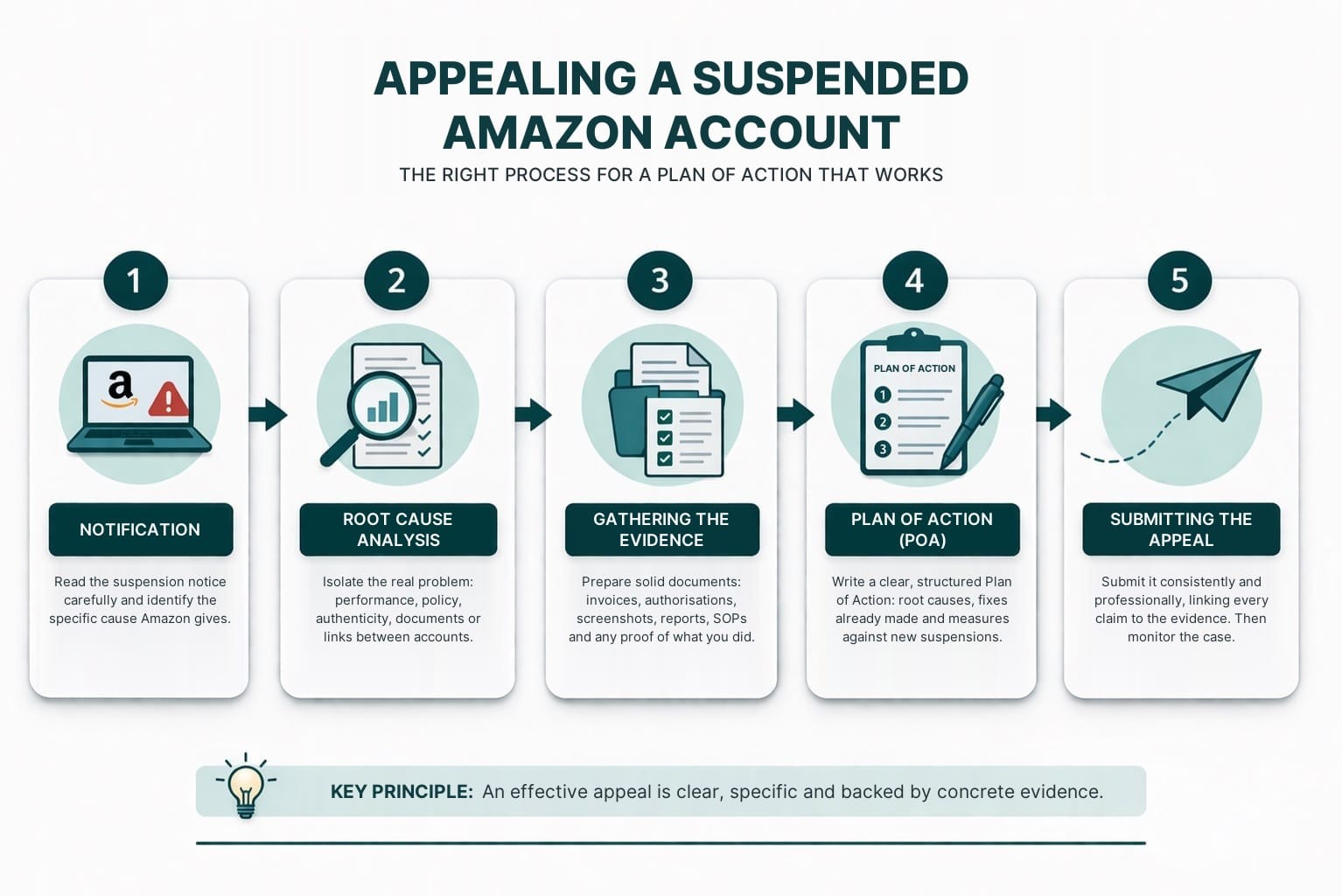
An effective appeal always follows the same sequence: notice, analysis, evidence, Plan of Action, submission.
What to do in the first 24 hours
The first hours matter. The worst mistake is reacting on impulse with an emotional message, or sending documents nobody checked.
- Open the right notice. Go to Seller Central, Performance, and read the communication in full.
- Identify the real problem. Ask whether the case is about metrics, policy, authenticity, documents or a related account.
- Freeze the pointless changes. Do not rewrite the whole catalogue without a clear reason.
- Gather the evidence. Invoices, contracts, screenshots, tracking, communications, procedures and internal records.
- Build a timeline. Amazon assesses facts better when they are in chronological order.
- Write a coherent appeal. Every statement has to be tied to a piece of evidence.
If the case touches authenticity or intellectual property, the quality of the documents weighs as much as the text of the appeal. If it touches performance, you also have to show the corrections already in place.
If you would rather hand the whole thing over, that is what we do on account reinstatement — including the release of withheld funds, which is usually the part that hurts most.
Rushing costs here: a weak appeal hardens the assessment and makes the second attempt harder. Before you send anything, let us read the notice and the documents you hold. We have worked on around 1,000 seller accounts.
How to write a Plan of Action Amazon can actually assess
The Plan of Action, or POA, is usually the heart of the appeal. It does not have to be long. It has to be credible, specific and verifiable.
The structure that works best
- Root cause: what actually went wrong.
- Immediate correction: what you have already fixed.
- Prevention: what will stop it happening again.
- Evidence: which documents prove the actions you claim.
1. Describe the root cause without defending yourself too hard
Amazon is not looking for a brilliant text. It is looking for a clear one. Explain the problem directly, without blaming the system or the customer.
If the suspension came from a weak process, say so. If it came from incomplete documents, say so. If it came from disorganised order handling, say so.
2. State the actions already completed
Vague promises convince nobody. Show what you have already done. You might have dropped a risky supplier, rewritten a procedure, trained the team, corrected templates, verified tracking or centralised document review.
3. Close with permanent controls
The preventive part is the one most appeals miss. Amazon wants to understand how you will avoid the problem in the coming months. That needs frequency, ownership and checks.
- Weekly audit of account health.
- Document review before every submission.
- Suppliers without a verifiable chain of custody blocked.
- Catalogue check before any new listing goes live.
- Internal escalation on claims and performance.
A Plan of Action template you can fill in
This is the outline we use internally on the cases we run. Copy it, fill in the bracketed fields and delete whatever does not apply to you: a long Plan of Action is not worth more than a short one — a verifiable one is.
1. Root cause
[What happened, in one or two sentences, with no justifications. Give the ASINs, dates and case numbers involved.]
[Why it happened: the process failure, not the bad luck. For example: no document check on incoming batches.]
2. Immediate actions already completed
[What you have already done, with the date. Completed actions only, not intentions.]
[Evidence attached: invoices, certificates, correspondence with the supplier, screenshots of the catalogue corrections.]
3. Preventive actions
[The new control that stops it recurring: who runs it, how often, and what evidence it produces.]
[The date it has been live from.]
4. Attachments
[A numbered list of the documents, in the same order you cite them above.]
Three rules that decide whether a plan is read or filed:
- Every statement needs an attachment behind it. If you cannot prove it, remove it.
- No argument and no personal history. The reader is looking for cause, remedy and prevention, in that order.
- Preventive actions have to be verifiable. «We will be more careful» is not a control; «document check on every incoming batch, carried out by the purchasing manager, with a signed register» is.
The difference between an accepted POA and a rejected one is not length: it is whether the cause you state matches the one alleged, and whether the evidence supports it. Let us read it before you submit.
Suspended and you do not want to get the appeal wrong?
Send us the notice you received, whatever you have already submitted, and the case history. Marche Web Marketing is an Amazon SPN partner with an in-house legal consultant, and the first analysis costs nothing. Have the case looked at.
The mistakes that almost always make it worse
The most expensive mistake is answering in the heat of the moment: a weak appeal is not neutral, it hardens the assessment and makes the next attempt harder. Most sellers lose valuable time on avoidable errors.
- Sending the same text repeatedly.
- Denying everything without evidence.
- Using a template copied off the internet.
- Attaching partial or unreadable invoices.
- Mixing unrelated cases into one appeal.
- Changing the story between one appeal and the next — contradictory versions stay on the record.
How to prevent the next suspension
Prevention is the real advantage. Amazon provides dashboards and indicators that let you act before the block.
A minimum control system should include:
- Weekly check of account health.
- Review of A-to-z claims and negative feedback.
- Monthly review of suppliers and invoices.
- A checklist before publishing new ASINs.
- A document archive that is current and easy to search.
- Clear ownership of who approves catalogue, orders and customer service.
Suspensions usually come from processes that are too improvised. That is why the best work does not start with the appeal. It starts long before, with operational control and clean paperwork.
What is Account Health Assurance, and who has it?
It is the protection Amazon gives to accounts with a long record of good health. You are enrolled automatically and at no cost if you are on the Professional plan, keep an Account Health Rating of at least 250 for at least six months (with no more than 10 days below it) and have a valid emergency contact number. The banner at the top right of the Account Health dashboard shows whether you are in.
In practice, when an issue could lead to deactivation, an Amazon specialist contacts you and explains what is wrong and how to fix it. If you respond within 72 hours and work with them, the account is not deactivated while you resolve it. Serious violations such as fraud or illegal activity are excluded: there Amazon can act immediately.
What is Seller Challenge, and when can you use it?
Announced by Amazon on 5 September 2026, it is available to sellers with Account Health Assurance. Once the standard appeal routes are exhausted, you can ask a specialist team to review a policy decision on your listings, with additional documentation. Amazon aims to decide within 48 hours.
It can be used three times every 180 days. If accepted, the earlier decision is reversed and the listing is reinstated; a rejected challenge becomes available again after six months. It covers listing-level decisions, not the suspension of a whole account: for that, the appeal with a Plan of Action remains the route.
What Amazon says — and what European law adds
The official sources help you read the problem with more clarity. Amazon ties account health to policy compliance, service quality and how disputes are handled. That framework runs through the Business Solutions Agreement and the seller support pages.
The Account Health Rating exists precisely to flag when a profile is at risk of deactivation. On performance, Amazon is explicit: an Order Defect Rate above 1% can lead to restrictions on selling privileges. A-to-z claims also count towards the perceived quality of the account, which is why Amazon asks for them to be handled quickly and traceably.
The part most English-language guides leave out
If you sell on a European marketplace, Regulation (EU) 2019/1150 — the Platform-to-Business Regulation — applies to the relationship between you and Amazon, whatever country your company is registered in. It places three obligations that matter directly when an account is stopped:
- Reasons and notice. Before terminating its services to a business user entirely, the platform must give the reasons on a durable medium with at least 30 days’ notice (Art. 4). The notice period does not apply where the termination is required by law.
- A free internal complaint system that is easily accessible and handles complaints «swiftly and effectively» (Art. 11).
- Mediation. The terms and conditions must name at least two mediators you can turn to when the internal complaint does not resolve matters (Art. 12).
This does not mean every seller is automatically right. It means that a Plan of Action which simply apologises is a plea for leniency, while one built on the reasons Amazon is required to give is a documented challenge — and that they are read differently. The text of the Regulation is on EUR-Lex.
Alongside it, the Digital Services Act requires large platforms to be more transparent about moderation decisions and gives users a route to contest suspensions and restrictions. Again: not a guarantee of being right, but a framework in which an ordered, motivated, documented challenge carries weight.
Finally, one figure explains the marketplace’s rigidity. In its 2024 Brand Protection Report Amazon states it verified over 2.5 billion units through Transparency across 88,000 brands, pursued more than 24,000 bad actors since 2020, and seized or disposed of over 15 million counterfeit products in 2024 alone. In that context, any signal of risk is treated severely.
Which documents you actually need, by cause
There is no universal pack. The right documents depend on why the account was stopped. Irrelevant attachments lengthen the review and confuse the case.
If the problem is authenticity or provenance
- Complete, legible, recent invoices.
- Supplier details that can be verified.
- Consistency between the products invoiced and the ASINs challenged.
- Brand authorisations or distributor letters where they exist.
- Images of packaging, labels and codes.
The quality of the proof matters here. An invoice that is cropped, partial or inconsistent with the catalogue loses its force.
If the problem is identity and document verification
- A valid identity document.
- A company registry extract consistent with the profile.
- A utility bill or proof of address with matching details.
- A bank statement or proof of the account used.
- Official translations where the originals are not in the marketplace’s language.
The most important criterion is consistency. Company name, address, legal representative and banking details have to agree with each other.
If the problem is performance and service
- Order history and tracking.
- The record of refunds, claims and customer messages.
- New fulfilment and control procedures.
- Evidence that the team has been trained.
- Internal reports showing the checks already running.
In these cases Amazon wants to see a real operational improvement, not a promise.
- A timeline of the accounts involved.
- The corporate relationships, or the absence of them.
- Contracts, powers of attorney and transfer documents.
- An explanation of who had access and who was responsible.
- Proof of separation between teams, tools and people.
Related-account cases turn on detail. A precise reconstruction is worth more than a long defence. We cover this case on its own in Amazon account suspended for a related account.
Reinstatement depends on the violation alleged and on how strong the evidence is that you hold against it. Before spending on an appeal it is worth knowing whether the evidence is there: we look at the file and tell you — including when the answer is no.
How to organise the appeal file
Many sellers have the right documents and present them badly. Amazon should not have to find the connections on your behalf. Build an ordered file.
- Case cover: reason for the suspension, date, reference of the notice.
- Timeline: what happened, in chronological order, with clear dates.
- Plan of Action: the main text, short and specific.
- Attachments: numbered evidence, cited in the text.
- Index: a list of every file submitted.
A simple example helps. If the POA says you have dropped a risky supplier, attach the proof of the new procedure — do not merely declare it. If it says you have tightened tracking control, show the flow or the verification register.
This reduces ambiguity, and it helps if Amazon asks for additions: you already have a coherent, reusable dossier.
Final checklist before you submit
There are eight things to check before you press send. They are simple, and they usually make the difference.
- You have answered the exact reason Amazon cited.
- You have separated facts, corrections and prevention.
- Every promise is supported by evidence.
- The documents are legible and consistent.
- You have not attached anything irrelevant.
- The tone is direct, professional and not argumentative.
- The text is not a generic template.
- The timeline is clear and complete.
If one of these is missing, stop and fix it. A rushed submission rarely helps.
Frequently asked questions
How long does Amazon take to answer an appeal?
It varies with the violation and the quality of the evidence: anywhere from a few days to several weeks. Anyone promising you a date does not know it.
Can I send several identical appeals to speed things up?
No. It slows the review and it harms the case. Repetition without new evidence reads as pressure, not as an argument.
What is the difference between a blocked ASIN and a suspended account?
A blocked ASIN stops one listing or family of offers. A suspended account removes your selling privileges entirely — and, in the more serious cases, holds the funds.
Do I always need a Plan of Action?
Not always. Document verification cases are closed with correct documents. Performance and policy cases almost always need one.
Reconstruct the real relationship between the accounts, with dates and documents, and show the operational separation. A defence without a timeline does not work here.
We are not based in the EU. Does that make it harder?
It makes the document stage harder, because the paperwork proving a company exists has to be read against European expectations. It does not make the appeal weaker — and Regulation (EU) 2019/1150 applies to the relationship regardless of where your company is registered.
With the account that caused the problem, not the related one. Amazon explains that the violation on the responsible account must be appealed and resolved first, in every store where it was deactivated. Only once that account is reinstated do you appeal the related one, quoting the storefront name of the reinstated account and the reinstatement date. Opening a new account to get around the issue leads to the automatic deactivation of every linked account. More in related-account suspensions.
In short: understand the reason first, then write
Amazon suspensions bring together compliance, documents, operations and communication. The right words are not enough on their own — it is a process problem.
Marche Web Marketing works on Amazon from inside the European Union and is an Amazon SPN partner, with an in-house legal consultant on the suspension cases and two external firms for the ones that need them. If your account is stopped, send us the notice: the first assessment is free, and if the case is weak we say so before you spend anything.
Suspensions, performance, compliance: talk it through with someone who does it daily. The 30-minute call is free.