

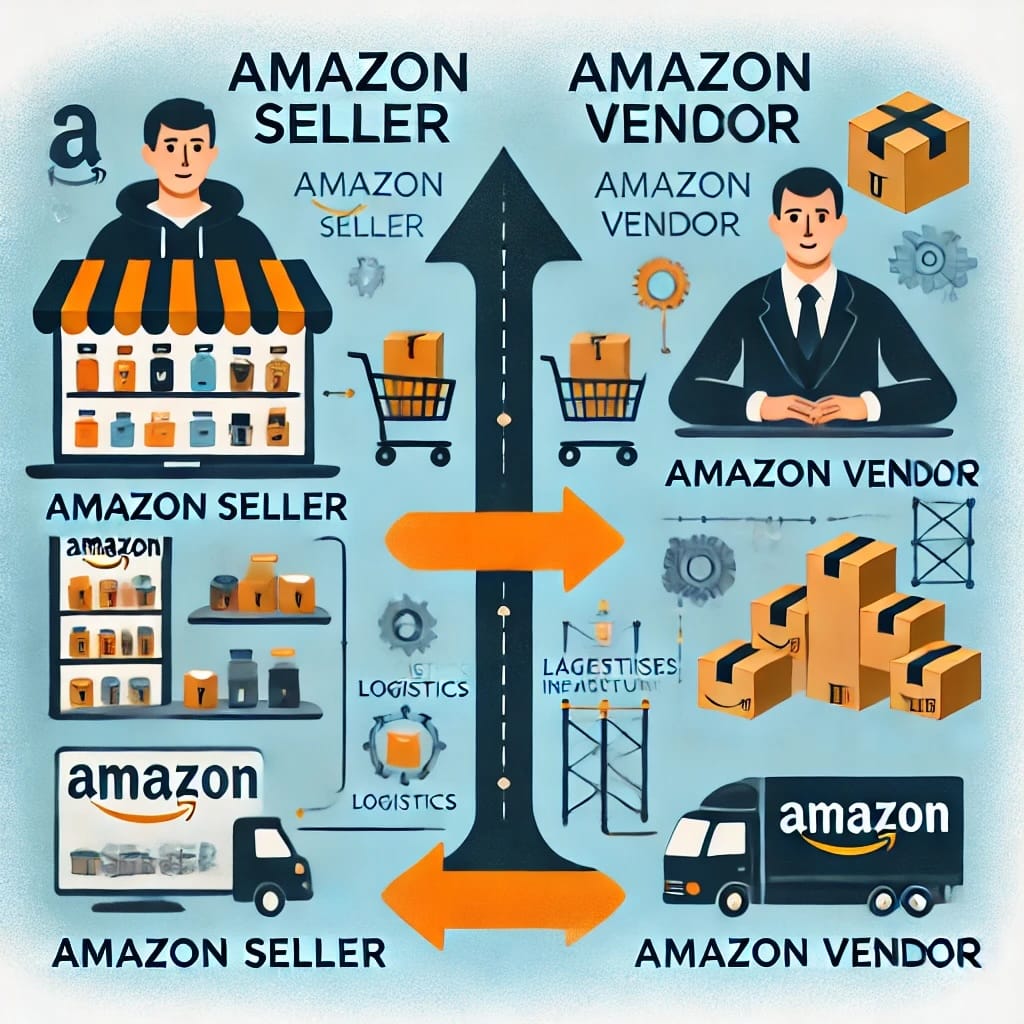
Most brands that leave Vendor do not leave because they wanted to. They leave because something happened: orders cut without warning, a product no longer replenished, a retail price dropped below what the rest of the distribution network could live with.
This piece is about when moving to Seller is the right answer to that — and when it is not.
What actually changes
On Vendor you sell your products to Amazon, which buys wholesale and resells to the end customer: Amazon is your customer. On Seller you sell to consumers yourself through the marketplace, keeping direct control of price, brand and the customer relationship.
The central issue is control of the margin. As a Vendor, Amazon sets the final price and the supply terms. As a Seller, you set price, promotions and the relationship with the buyer — and you carry the operation that goes with it.
The four things you get back
1. You decide price and promotions
As a Vendor the final price is Amazon’s, often driven by dynamic pricing and by promotions you did not choose. As a Seller you set your own prices, run your own discounts and campaigns, and can react to the market instead of discovering it afterwards.
For a brand that also sells through distributors or its own store, this is usually the decisive point: it is what stops Amazon’s price from setting everybody else’s.
2. You govern the brand
As a Seller you can enrol in Brand Registry in your own name, which gives you protection against infringements, A+ content on your pages, and a Brand Store. Advertising also becomes yours to aim: Sponsored Products and Sponsored Brands run against your own objectives rather than Amazon’s.
3. The customer becomes yours
As a Seller you see who buys, what they ask, and why they return things. You can act on the reviews and on the questions under the listing. On Vendor that information belongs to Amazon, and what you learn is what Amazon chooses to show you.
4. The margin stays with you
This is the one that has to be calculated rather than assumed. On Seller you keep the retail price less referral fees, logistics and advertising. On Vendor you keep the transfer price less your costs — and less the stack of allowances the agreement provides for: base accrual, damage, internal freight, Co-op and MDF, returns, unsold stock.
Those allowances are the reason the agreed Vendor revenue and the money that reaches the bank rarely match. We set them out one by one in how Vendor Central works.
It depends on volume, on margin per SKU, and on how much logistics and advertising you want to run yourself. We look at your numbers together and tell you frankly whether it makes sense.
How the move is made, step by step
- Open a Seller Central account. With the right legal entity and the right VAT position for the marketplaces in scope — this is where non-EU companies usually lose the most time.
- Enrol in Brand Registry. If the trade mark is registered, enrol it: it unlocks content and protection you do not have otherwise.
- Choose fulfilment. FBA, FBM, or a mix by product. It is a margin decision, not a logistics preference.
- Build the listings. On Vendor the content was Amazon’s; on Seller it is yours, and it has to be written for Amazon’s search, not Google’s.
- Set the prices. Including the floor below which the product stops being worth selling.
- Manage the stock. Nobody replenishes for you any more — and a stockout costs organic position, not only the sale.
- Switch on advertising. Demand that used to arrive through Amazon’s own machine now has to be captured.
The part that is usually underestimated
The transition is not a switch. For a period the same ASIN can carry both Amazon’s remaining stock and your offer, which means competing with Amazon on your own product page — at a price you do not control. Planning that overlap, rather than discovering it, is most of the work.
Tools you get as a Seller that you did not have
Amazon Vine lets you build the first verified reviews on a new listing, which matters enormously when the product has no history on your own account. Transparency assigns a unique code to every unit produced, so a buyer can verify authenticity from the Amazon app — the strongest tool available against counterfeits.
Neither is available to you as a Vendor in your own name, and both take time to set up. They belong in the plan before the move, not after it.
It needs a registered trade mark: if you have one, enrolment unlocks protection and A+ content. We check the requirements with you before you lose time on a rejected application.
When it is worth it, and when it is not
It is not the right choice for every brand. A company selling very high volumes that does not want to run logistics, advertising and customer service can still find Vendor convenient — and there is nothing wrong with that.
But for anyone who has already faced order cuts, imposed prices or suspended replenishment, moving to Seller is often the only way to take back direct control of price, brand and customer.
The decision is made on your own numbers — margin per SKU, logistics capacity, internal structure — not on a sector average. And it is made before you give notice, because the Vendor agreement renews automatically for 12 months unless written notice is given at least 60 days ahead.
Frequently asked questions
Can I keep both Vendor and Seller?
Yes, and many established brands do: high-rotation lines on Vendor, everything that needs price and launch control on Seller. What it requires is a clear rule on which ASINs sit where.
How long does the transition take?
The account itself opens in days. Getting the catalogue, content, stock and advertising to the point where they carry the volume Amazon used to buy takes months, and it should overlap with the last Vendor orders rather than follow them.
Will I lose the reviews on my products?
The reviews belong to the ASIN, not to the seller. If you list on the same ASIN, the review history stays.
We are outside the EU. Does this change the move?
It adds a layer. On Vendor, Amazon EU Sàrl was buying from you and placing the goods on the European market. On Seller, that responsibility becomes yours — VAT registration, EPR and packaging obligations, and an economic operator established in the Union under the GPSR. It is doable, and it is the part to settle before opening the account rather than after the first listing is taken down.
If you want the two numbers side by side
We run both Seller and Vendor accounts, and we have worked on Amazon since 2011 from inside the European Union. If you are weighing the move, write to us: the first 30-minute call is free, and we will tell you if the arithmetic says stay.
We have run Seller and Vendor accounts for years. Book a free 30-minute call with an SPN-certified specialist.